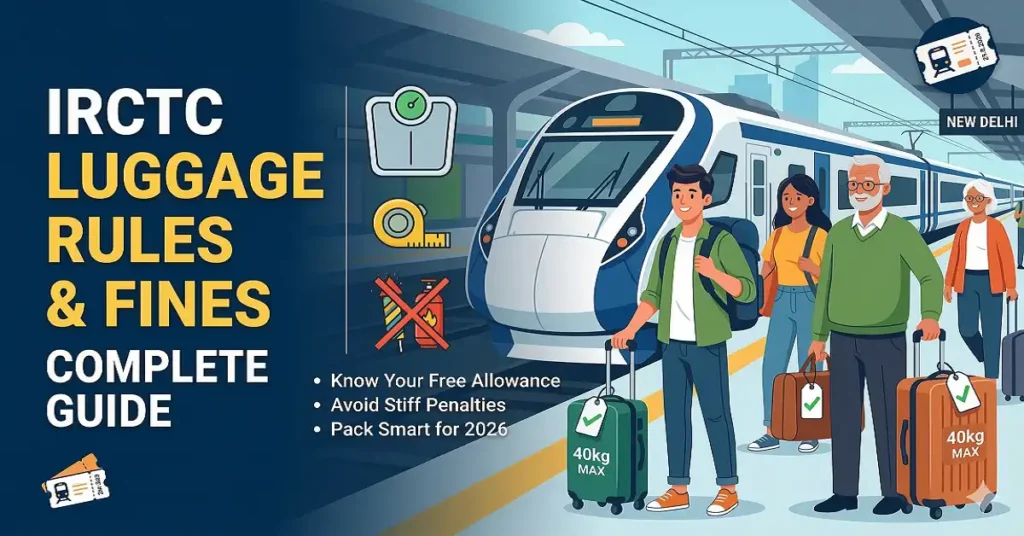
Every day millions of people travel on Indian Railways. When traveling by train, passengers usually carry bags, suitcases, or cartons. But many travelers do not know that Indian Railways has strict luggage rules.
If you carry luggage beyond the allowed limit, you may have to pay extra charges or even a penalty.
Many passengers get fined simply because they are not aware of these rules. This guide explains IRCTC luggage rules in simple language, so that anyone can understand them easily
In this article you will learn:
- Free luggage limits for each train class.
- Maximum luggage allowed.
- Extra luggage charges.
- Penalties and fines.
- Size restrictions for bags.
- Items that are not allowed on trains.
Let’s start with the basics.
Why Indian Railways Has Luggage Rules?
Indian trains carry hundreds or sometimes more than a thousand passengers in a single train.
If everyone carries unlimited luggage, it creates problems such as:
- Blocked walking space in coaches.
- Difficulty for passengers to sit comfortably.
- Safety issues during emergencies.
- Overloading of train compartments.
To prevent these problems, Indian Railways created luggage limits based on travel class.
Passengers can carry luggage within the free allowance without paying anything.
Free Luggage Allowance in Indian Railways
The free luggage limit depends on the class of ticket you book.
Passengers traveling in higher classes are allowed to carry more luggage compared to sleeper or general class passengers.
Below is the official free luggage allowance.
| Travel Class | Free Luggage Allowed | Maximum Allowed (With Payment) |
|---|---|---|
| AC First Class (1AC) | 70 kg | 150 kg |
| AC 2 Tier | 50 kg | 100 kg |
| AC 3 Tier | 40 kg | 40 kg |
| AC Chair Car | 40 kg | 40 kg |
| Sleeper Class | 40 kg | 80 kg |
| Second Sitting / General | 35 kg | 70 kg |
Important points:
- You can carry luggage within the free limit without any charges.
- If luggage exceeds the free limit, you must pay excess luggage charges.
- Luggage above the maximum limit is not allowed inside the coach.
Understanding Free Allowance with an Example
Let’s understand this with a simple example.
Suppose you are traveling in Sleeper Class.
- Free allowance = 40 kg
- Maximum allowed = 80 kg
Scenario 1:
If you carry 35 kg, there is no charge.
Scenario 2:
If you carry 50 kg, you must pay charges for 10 kg extra luggage.
Scenario 3:
If you carry 85 kg, this is above the maximum limit and may lead to penalties.
Excess Luggage Charges in Indian Railways
If your luggage weight exceeds the free allowance, Indian Railways will charge you extra.
The rule is simple:
Extra luggage is charged at 1.5 times the normal luggage rate.
This means you pay 50% more than the standard luggage rate.
Example
Passenger traveling in AC 2 Tier
- Free limit = 50 kg
- Passenger luggage = 65 kg
- Extra luggage = 15 kg
The passenger must pay extra luggage charges for 15 kg.
These charges can be paid at the parcel office at the railway station.
What Happens if You Do Not Declare Extra Luggage?
- Many passengers ignore these rules and carry excess luggage without booking it.
- However, Indian Railways officials sometimes check luggage weight during travel.
- If they find excess luggage that was not declared, passengers may face heavy fines.
Penalties for Excess Luggage (2026 Rules)
The penalty depends on the situation.
| Situation | Penalty |
|---|---|
| Slightly above free limit | Normal excess luggage charges |
| Excess luggage without booking | Up to 6 times the luggage rate |
| Luggage above maximum allowed weight | Heavy penalty + charges |
| Commercial goods carried in passenger coach | Penalty and confiscation |
Minimum penalties usually start from ₹50, but they can become much higher depending on luggage weight.
In some cases, railway staff may ask passengers to shift the luggage to the parcel van.
Size Limits for Luggage
Indian Railways also has restrictions on luggage size.
The maximum allowed dimensions for personal luggage inside the coach are:
100 cm × 60 cm × 25 cm
If your luggage is larger than this size, it should be booked separately as parcel luggage.
Examples of oversized luggage:
- Large cartons
- Big furniture pieces
- Large appliances
- Industrial equipment
These items cannot be kept inside passenger coaches.
How to Book Extra Luggage in Indian Railways?
If you know that your luggage will exceed the free limit, the best option is to book it legally at the railway station.
Here is the process.
Step 1
- Visit the Parcel Office at the railway station.
Step 2
- Show your train ticket.
Step 3
- Weigh your luggage.
Step 4
- Pay the required luggage charges.
Step 5
- Railway staff will issue a luggage booking receipt.
This ensures that you will not face penalties during the journey.
Items Not Allowed as Personal Luggage
Some items are completely prohibited in passenger coaches for safety reasons.
Passengers should never carry the following items.
Dangerous Items
- Explosives
- Fireworks
- Petrol or diesel containers
- Gas cylinders
- Highly flammable chemicals
Hazardous Materials
- Acid or corrosive liquids
- Toxic chemicals
- Industrial chemicals
Commercial Goods
Passenger coaches are meant only for personal luggage.
The following are not allowed:
- Large quantities of goods for sale
- Shop merchandise
- Bulk products for business
Such items must be booked through Indian Railways parcel services.
Special Luggage Rules for Families
Many families travel with multiple bags.
Here is something important to know.
The luggage allowance is per passenger, not per ticket.
Example:
Family of four traveling in Sleeper Class.
- Free allowance per passenger = 40 kg
- Total family allowance = 160 kg
So the family can carry 160 kg luggage without charges, as long as it is properly distributed.
Tips to Avoid Luggage Fines During Train Travel
Many passengers get fined simply because they do not plan properly.
Here are some simple tips to avoid problems.
1. Pack Smart
- Avoid carrying unnecessary luggage.
- Carry only items that are actually needed.
2. Weigh Your Bags
- Use a small luggage weighing scale before leaving home.
3. Use Medium Size Bags
- Very large suitcases may violate size rules.
4. Book Extra Luggage Early
- If you have heavy luggage, book it at the parcel office.
5. Avoid Carrying Business Goods
- Passenger coaches are meant only for personal travel.
Difference Between Luggage and Parcel
Many passengers confuse luggage with parcel service.
Here is the difference.
| Feature | Luggage | Parcel |
|---|---|---|
| Who carries it | Passenger | Railway staff |
| Where it stays | With passenger | Parcel van |
| Weight limit | Limited | Very high |
| Booking required | Only if excess | Always required |
Parcel service is usually used for:
- Moving household items
- Sending goods to another city
- Transporting heavy equipment
Common Mistakes Passengers Make
These mistakes often lead to fines.
Carrying Too Many Bags
- Passengers sometimes carry 6–8 bags, which block walkways.
Bringing Large Cartons
- Oversized cartons are not allowed in coaches.
Not Declaring Extra Weight
- Many passengers hide extra luggage, which can lead to penalties.
Carrying Commercial Products
- Goods meant for business must be transported through parcel service.
Are Luggage Checks Common?
Luggage checks are not done on every train, but they do happen.
Railway staff may check luggage in situations like:
- Festival travel rush
- Long-distance trains
- Passenger complaints
- Security inspections
So it is always safer to follow the rules.
Final Thoughts
Indian Railways luggage rules are simple, but many passengers ignore them.
Understanding these rules can help you:
- Avoid unnecessary fines
- Travel comfortably
- Keep train compartments organized
Here is the most important thing to remember:
- Stay within the free luggage allowance whenever possible.
- If luggage exceeds the limit, book it legally at the parcel office.
Following these simple steps will make your train journey smooth and stress-free.